
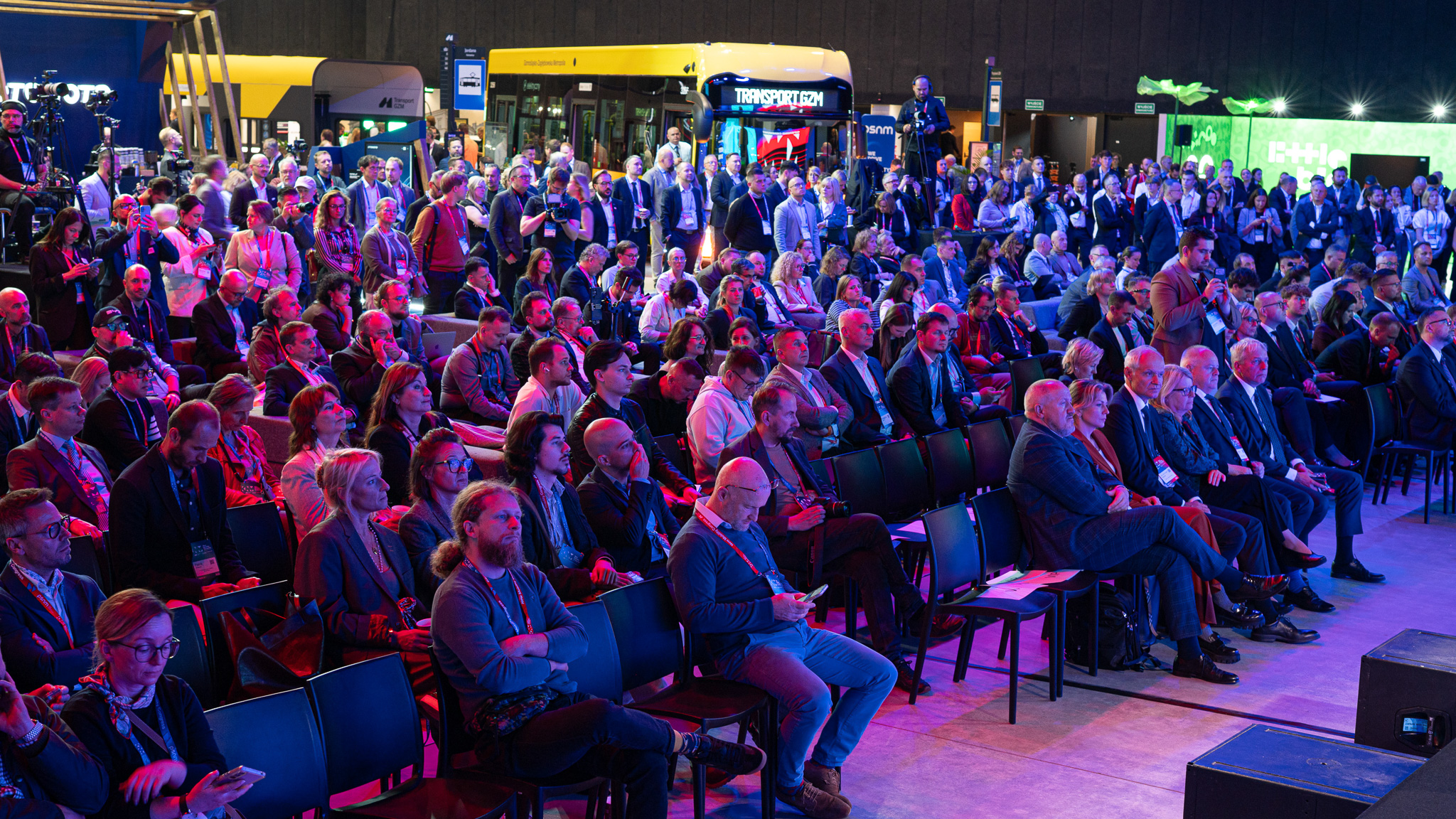
New Mobility Congress 2026 – from strategic debate to action
9,500 participants, more than 600 speakers and a series of decisions that set the framework for transformation – the seventh edition of the New Mobility Congress, the largest event in Central and Eastern Europe dedicated to the future of the economy, transport and cities, is now behind us. The key takeaway from this year’s KNM is clear: the transformation of Poland’s automotive industry is no longer an option, but a necessary condition for maintaining the competitiveness of the economy. Poland’s future position in global supply chains will be determined not by labour costs, but by skills and expertise.
From 23 to 25 September, Katowice once again became the centre of debate on the directions of transformation. The importance of the seventh edition of the Congress was reflected not only in the presence of more than 600 speakers from 400 countries, but also in the record attendance of representatives of the government administration. The official opening was attended by, among others, Krzysztof Gawkowski, Deputy Prime Minister and Minister of Digital Affairs, and Marcin Kulasek, Minister of Science and Higher Education. The event was also attended by Dariusz Klimczak, Minister of Infrastructure; Miłosz Motyka, Minister of Energy; Eliza Zeidler, Secretary of State at the Ministry of State Assets; and Maciej Wróbel, Secretary of State at the Ministry of Culture and National Heritage.
“The New Mobility Congress is a place where we discuss the future across sectors and how to harness the potential of a state that can be proud of its economic development. Mobility is a reflection of a modern state that embraces the technological revolution created primarily for people. This is precisely what we discuss here in Katowice,” said Krzysztof Gawkowski, Deputy Prime Minister and Minister of Digital Affairs, during the official opening of KNM.
One of the key elements of the KNM 2026 programme was the presentation of the “Compass 2035” strategy – a plan for transforming Poland’s automotive industry. Its objective is to build a competitive, modern and resilient economy based on innovation, battery technologies and software, and therefore on investment in people, skills, infrastructure and Poland’s economic security.
“In Katowice, we have built something that does not exist anywhere else in Central and Eastern Europe: a place where the automotive, energy, aviation, construction and security sectors jointly plan the transformation. On a daily basis, these worlds operate separately, yet the success of the transformation will depend on whether they start working together. That is why KNM is now much more than a congress – it is a joint project for the Polish economy. After these three days, we have set ourselves a clear goal: the time for discussion is over; the time for implementation has begun,” said Maciej Mazur, President of PSNM.
New Mobility Congress 2026: transformation as part of strengthening national resilience
Poland produces more than 611,000 vehicles annually, while exports of vehicles and components amount to nearly EUR 33 billion, and the sector employs more than 190,000 people. As the “Compass 2035” strategy points out, this potential has been built primarily on component manufacturing and competitive labour costs, while an increasing share of added value is being created elsewhere – in batteries, electronics and software. The Polish Mobility Code, announced at KNM 2026 by Deputy Prime Minister Krzysztof Gawkowski and Minister of Science Marcin Kulasek, addresses this gap. The initiative is intended to help Poland develop its own technologies and manufacturing capabilities in the electromobility sector, from software and components to finished products.
The transformation of industry cannot take place without cities, as they are the first market for new technologies – from electric buses and charging infrastructure to traffic and energy management systems. This is why the 250-point KNM 2026 programme devoted so much space to the extensive “New Cities & Urban Innovation” and “New Architecture & Construction” tracks. This is where designers and architects met with vehicle manufacturers and energy suppliers to discuss how to build cities ready both for new technologies and for climate change. Katowice is the best example of how such a transformation is possible. A city that for decades relied on mining and heavy industry has undergone the same journey that Poland’s automotive industry is now facing – from traditional manufacturing to an economy based on technology and skills.
“The New Mobility Congress has once again demonstrated that the future of transport is not a distant vision, but a set of solutions that we are already implementing,” says Igor Śmietański, Deputy Chairman of the Management Board of the GZM Metropolitan Area. “Our zone, where we presented, among other things, an electric bus and the latest solutions being developed by GZM for modern, integrated and more environmentally friendly transport, attracted considerable interest. This shows that residents and industry representatives are curious about what is happening in the Metropolis and what the transformation of transport looks like in practice. Such meetings are important because they allow us to discuss together what the transport of the future should look like and what solutions we should develop to create that future already today” he adds.
“Transformation is never a process that is fully complete. It is a process that requires consistency, investment and cooperation between many different stakeholders. Our experience shows, however, that changing an economic model is possible if we start building new skills and creating the conditions for the development of new industries early enough. Events such as the New Mobility Congress help us exchange experiences, seek new partnerships and discuss how we can jointly respond to the challenges associated with industrial transformation and the development of new technologies. We believe that cooperation between local governments, business, academia and residents makes it possible to create a lasting foundation for the next stage of development of our cities and regions,” says Marcin Krupa, Mayor of Katowice.
New Mobility Congress 2026: premieres and innovations strengthening the industry perspective
Six new electric models from the Volkswagen Group, the latest Renault Twingo E-Tech Electric, the Mazda CX-60e, Suzuki eVitara, the first Polish hydrogen-powered tractor unit, the first electric aircraft registered in Poland, and a battery-swapping system that takes three minutes – these were among the most important premieres and innovations presented during the New Mobility Congress 2026. Katowice also saw the presentation of BarAir, a technology enabling the construction of lightweight shelters and infrastructure protection systems in just a few minutes, as well as DARTS-PL – a Polish research vehicle equipped with 20 sensors, used to create a database of scenarios for future autonomous vehicles.
The New Mobility Congress 2026 concluded with fire safety training attended by nearly 200 officers from across Poland. The training was organised by the Polish New Mobility Association in cooperation with CNBOP-PIB, with the support of the State Fire Service and F5A New Mobility Research and Consulting.
Contact
Maciej Gis, Director of the PSNM Communications Office
e-mail: maciej.gis@psnm.org; tel.: (+48) 606 740 357
Jan Wiewiór, PR Specialist at PSNM
e-mail: jan.wiewior@psnm.org; tel.: (+48) 608 019 500
ABOUT GZM
The Upper Silesian-Zagłębie Metropolis (GZM) is an association of 41 cities and municipalities in Upper Silesia and the Zagłębie region, with a population of more than 2 million. The Metropolis harnesses the potential of its municipalities to improve residents’ quality of life and strengthen the region’s competitiveness. One of GZM’s most important responsibilities is the organisation and development of an integrated transport system. Under the Transport GZM brand, it brings together buses, trams, trolleybuses, bicycles and regional rail, creating one of the largest public transport systems in Europe. GZM is also developing Metrorower – Poland’s largest public bicycle-sharing system – and consistently strengthening the role of rail as the backbone of the future metropolitan transport system. GZM’s activities also include economic development, education and science, climate and environmental protection, and the development of leisure opportunities. The Metropolis provides a platform for cooperation between local governments, universities, business and residents, as well as a place for implementing modern solutions to the challenges facing contemporary cities.
ABOUT KATOWICE
For many years, Katowice has been involved in numerous initiatives and projects, including those supported by EU funding, aimed at encouraging changes in transport habits. The city has modern interchange hubs, its tram infrastructure is being expanded, and electric buses operate as part of the public transport fleet. Katowice was the first city in Poland to fulfil the provisions of the electromobility act and meet the statutory obligation to build the required infrastructure. Today, more than 200 charging points are in operation across the city. The city is also continuously investing in cycling infrastructure, developing a network of bike stations and cycle paths, which currently extend for more than 200 km, including the region’s longest velostrada, measuring 4.4 km. The wide range of available options means that Katowice residents are increasingly choosing bicycles as a means of transport, using public transport more frequently, while the popularity of electric vehicles is also growing. Katowice has received numerous accolades for its activities in this area. The city ranks highly in various rankings and has also received distinctions and awards in competitions promoting sustainable development.